
By Carl W8WZ
Winter Field Day (WFD) 2026 was the second Winter Field Day for the Pinecone Amateur Radio Club (PARC); the club having formed shortly before the event in 2025. In 2025, Brantley K4CBW and John K4EB operated together from a rented cabin at Morrow Mountain State Park in Western North Carolina. We decided not to duplicate that effort in 2026 because, under John’s leadership, the Raleigh Amateur Radio Society was supporting an ARISS contact between a local school and an astronaut on the International Space Station that week. John, Brantley, and Carl were all involved in that effort and therefore didn’t have the time or energy to travel far for a WFD event the same week as the ARISS activation.
So, at first it looked as if PARC would not participate in WFD 2026 at all, but then logistics changed. The exact date of the ARISS contact was still TBD when Carl had to make his travel plans to North Carolina from New Orleans to be part of it, so he decided to just visit North Carolina for a 10-day spread in late January so that no matter what date got selected for the ARISS contact, he would be there. This meant that he would be renting an Airbnb during the weekend of WFD in a town halfway between Raleigh and Fayetteville. This gave PARC an opportunity to do WFD from that location, in the Indoor category without having to travel far from Raleigh and therefore WFD would be doable even with the ARISS contact looming.
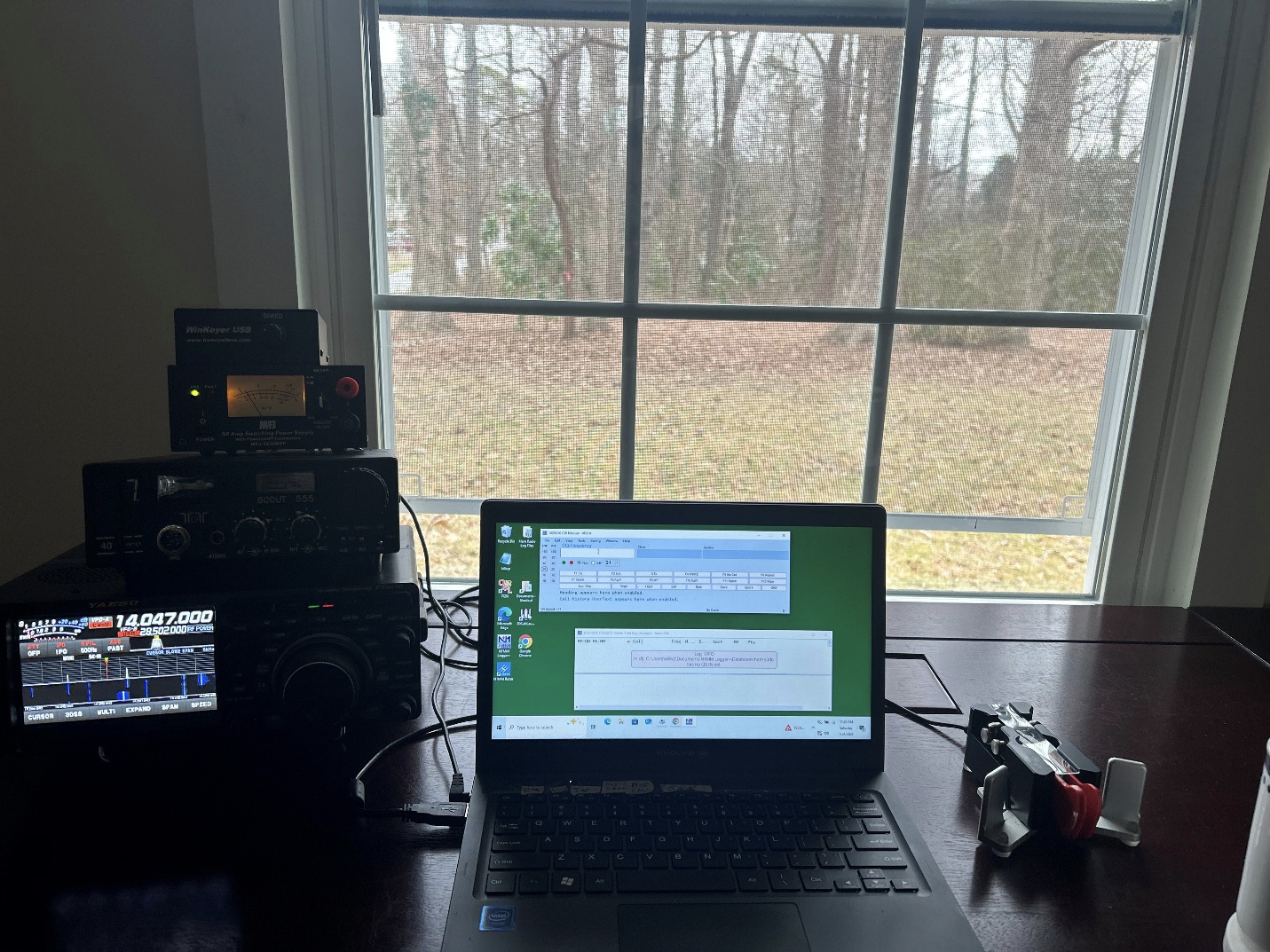
Carl selected an Airbnb with lots of tall trees and arranged to borrow an FTDX10 station from the Raleigh Amateur Radio Society during his visit. John had PARC’s 80-10 My Antennas EFHW antenna and Brantley had coax. Carl brought his Heil headset and Begali traveler key with him along with a laptop loaded with N1MM software and Winkeyer. It looked like all was a go! However, the weather had other plans. Carl landed at RDU on Friday just before a major snow and ice event was predicted to clobber the Eastern seaboard. He went directly to Brantley’s house where he picked up the radio gear and then went to the Airbnb to set up, stopping at a grocery store for provisions along the way. Because of the impending storm, neither John nor Brantley would be able to come to Carl’s Airbnb to operate, so it would be a one-person operation this year, ironically, the one person who did NOT operate last year would be the only one operating this year! We all thought that our antenna was stored at Brantley’s house, but upon actually looking for it in his garage on Friday we realized that John had it! So, on Saturday morning, Brantley went to John’s house where he picked up the antenna and a sleeping bag loaned to Carl by John, in case the Airbnb lost power during the storm, and the house would have no heat. Brantley arrived at Carl’s Airbnb late morning and installed the antenna in one of the tall oaks in the back yard then hurried back home before the storm hit. The antenna was installed as an Inverted-V and fed with 100’ of coax, through a window in the bedroom of the house.
At first the noise floor appeared to be about an S7 but once the antenna’s feed point transformer was located about 20 feet away from the property’s edge where power lines ran along the road, the noise went down to S1. Being a one-person operation in the 1I category, Carl decided not to take a competitive attitude towards the contest, instead he considered it a fun way to entertain himself during the snowstorm. The radio station was set up on a desk under a window looking out into the wooded back yard so he could watch the snow fall as he made QSOs throughout the day. Because of that, no effort to obtain bonus points was made, the entire focus was simply on QSOs. Last year, Carl worked John and Brantley doing Winter Field Day at Morrow Mountain from a portable station he set up in a parking lot in New Orleans. This year John and Brantley both worked Carl from their homes while he was operating WFD from the Airbnb, John on 40 SSB and Brantley on 20 CW (pushing the limits of 100W groundwave). The station worked flawlessly for the entire contest.
Taking a non-competitive attitude meant that Carl took meal breaks, taking time to cook and eat 3 meals during the course of the contest and slept 9 hours overnight. It was a very civilized pace. Even with those accommodations the station racked up a very respectable 632 (non-dupe) contacts. The total number was 661 if you counted dupes. A break down of band/mode is in the chart below. Because Carl slept all night, most of the operating was done during the day, therefore it is not surprising to see 20 meters as the most productive band. Had he stayed up overnight one would expect to see better performance on the lower frequencies.
| BAND | MODE | QSO | POINTS |
|---|---|---|---|
| 3.5 | CW | 42 | 84 |
| 7 | CW | 125 | 250 |
| 7 | SSB | 22 | 22 |
| 14 | CW | 327 | 654 |
| 14 | SSB | 116 | 116 |
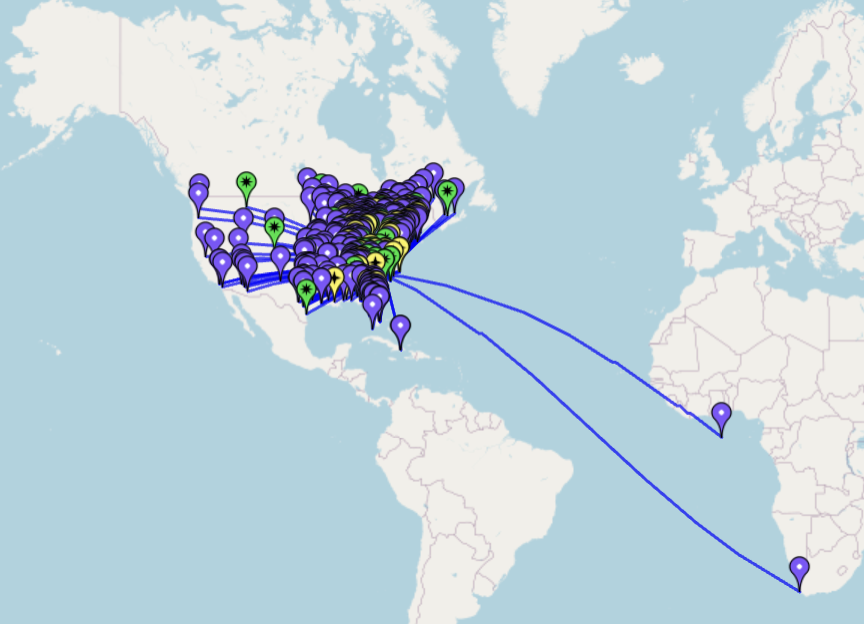
Here is a map showing all of the contacts made. As you can see, the best DX was South Africa and most contacts were in the USA East of the Rockies, but a good coverage of the entire North American Continent was had. The percentage of contacts made with US stations East of the Rockies is likely a combination of the following factors:
- Population density in those places.
- Take off angle performance of the EFHW Inverted V antenna.
- Time of day contacts made impacting propagation. Had Carl operated in the evening on lower frequencies one would expect to see a different coverage pattern emerge from that.
When the contest ended, Carl emailed the log file to John who uploaded it to Logbook of the World (LOTW) (where PARC now has 2,900 QSOS) and John submitted it as an official entry on behalf of PARC (N4BCJ). So, it was truly a team effort – Brantley installed the antenna, Carl did the operating, and John did the “paperwork”. Carl got the good part of the deal this year!
After supporting the ARISS contact, Brantley, John, and Carl spent an afternoon doing POTA activations around the area and brainstormed on a strategy for Winter Field Day 2027. Maybe that will be the year that all three of us finally get to operate this contest together!