The North Carolina QSO Party is a contest that Carl, John, and I look foward to every year. For me, it’s second only to Field Day, and a very close second.
For stations outside of North Carolina, the goal is to contact as many North Carolina-based stations as possible. For those of us in North Carolina, we are the “DX” and aim to work everybody. Multipliers are awarded for NC counties and US states (and one for DX). This year the NCQP committee decided to incentivize operating in the ten-least active North Carolina counties based on last year’s contest results. Contacts with these counties are worth 10x the normal value.
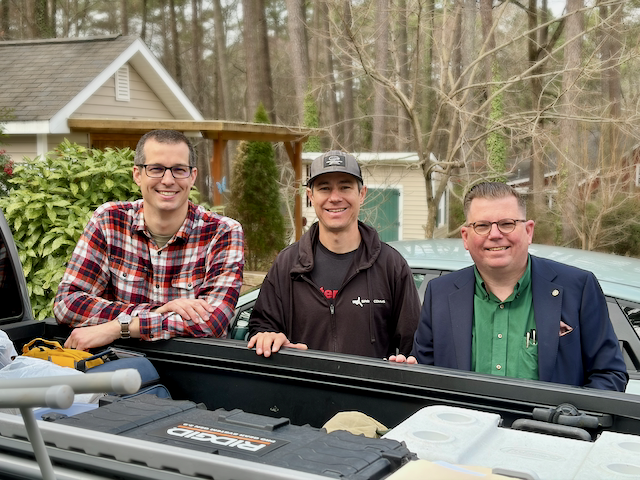 Departure time from Raleigh. L-R: Brantley K4CBW, John K4EB, Carl W8WZ
Given the Pinecone Amateur Radio Club’s proclivity for portable operating, we decided to take our show on the road (once again!) to one of the ten rare counties. We narrowed our list down to Pamlico, Caswell, and Person counties. We were drawn to Pamlico county for the saltwater and the superior Airbnb options. This county is home to the small town of Oriental, the “Sailing Capitol of North Carolina.” This past weekend we made waves of our own!
The rental house sits on three acres with tall pine trees (90’+) and backs up to Spice Creek. A 120-foot dock extended over the marsh into the creek and provided a pleasant perch from which to observe fish and waterfowl. Three bedrooms ensured plenty of space to stay comfortable.
Final planning occurred the Wednesday before the contest via Zoom. John, Carl, and I met to discuss logistical details including departure and arrival times, final equipment assignments, and the weather briefing.
POTA + Setup
We met on Saturday morning at 10:00 AM in Raleigh and were rolling out of the driveway with a truckload of equipment at 10:30 AM, destination: New Bern. We arrived shortly after noon at Tryon Palace where we had chicken salad croissant sandwiches for lunch and activated for Parks on the Air. After some initial difficulty with QRP, we switched to John’s 100W Yaesu FT-891 to speed up our activation and get back on the road. We hit a grocery store and made one more POTA stop at Neuse River State Game Land before continuing to our accomodations.
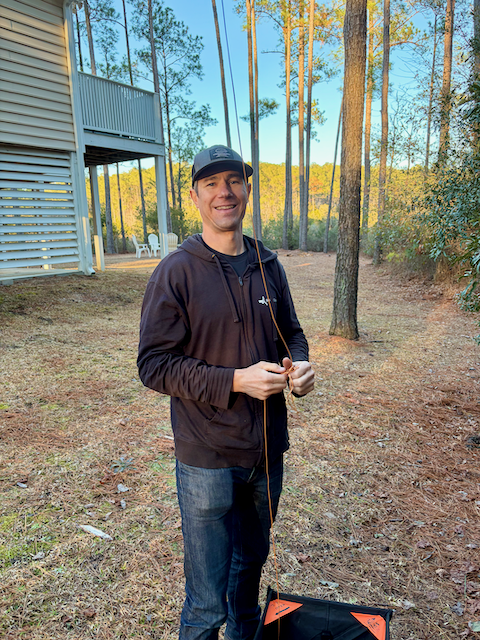 John K4EB working on the EFHW.
We arrived at the house around 4:30 PM and promptly began scouting antenna locations. We prioritized the inverted-L end-fed halfwave (EFHW) and 40-meter dipole due to their excellent performance at Field Day last year. We decided to hang our EFHW and 40-meter dipole together in one plane using a large opening in the canopy that would allow us to aim the lobes of the antenna east/west. John shot the lines over the trees and pulled up a Prusik knot to anchor the 80’ bend in the inverted-L. We added 20’ of paracord to the 50’ EFHW horizontal section and tied on the 40-meter dipole. We hoisted the other end of the 40m dipole up until both antennas were over the house. There was some sag in the antennas due to their weight and the weight of the RG8X feedline, which was expected.
After the two “primary” antennas were up, we looked for a place to put an NVIS 80/40-meter dipole. The NVIS antenna is built around a 14-gauge 80-meter dipole. Additional 24-gauge 40-meter elements were added underneath. Drinking straws were used to space the 40 and 80-meter elements and were secured with duct tape. We decided to make use of the dock to extend one of the legs of the antenna. The other end was dog-legged around side of the yard. The feedpoint of the antenna was ~20-feet in the air and the ends of the 80-meter dipole were 6’ in the air. We returned to this antenna Saturday morning to attach a clip lead to each end of the 40m NVIS elements. This lowered the 40-meter resonant frequency from 7.37 MHz to 7.0 MHz.
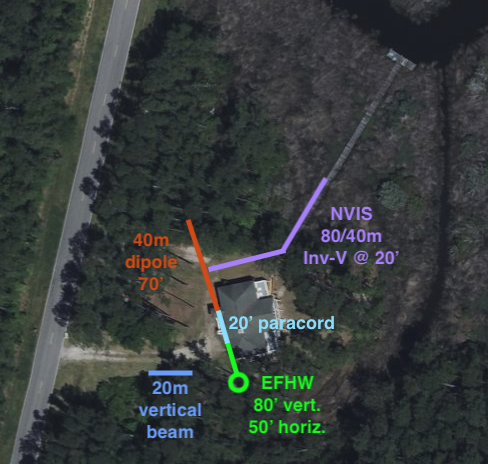 Antenna placement
During station setup Saturday night, I discovered that I had forgotten a power cable for my 12V power supply. This might be the ONLY piece of station equipment that could be replaced at Walmart, and I did just that right before the store closed at 11pm.
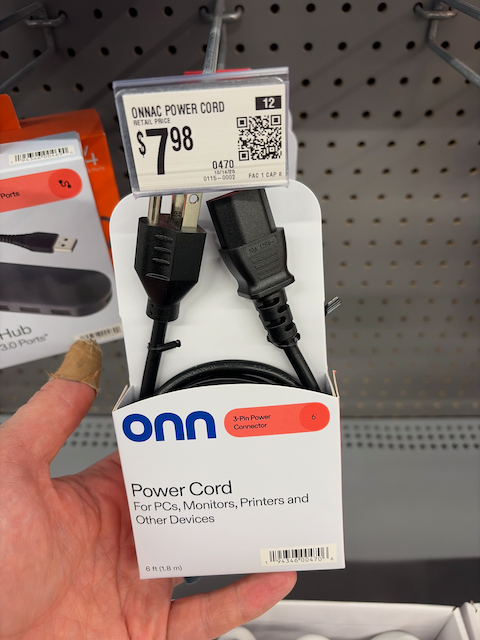 Most heralded and category-preserving power cord.
Contest Time
When the contest started at 10:00 AM EST Sunday, we began calling CQ. However, we quickly ran into some RFI problems between the stations. We found that the EFHW antenna interfered with the 40m dipole and 20m beam, making the NVIS antenna a necessity. We continued to monitor both stations for interference when changing bands or antennas. The 20-meter vertical beam on CW and the 40-meter dipole on phone was a productive combination.
Throughout the day, we found spotting ourselves on the the following websites was helpful in maintaining a good rate:
- NC QP spotting page
- http://qsopartyhub.com/ncqp-spots.php,
- http://www.dxsummit.fi/
- https://dxwatch.com/
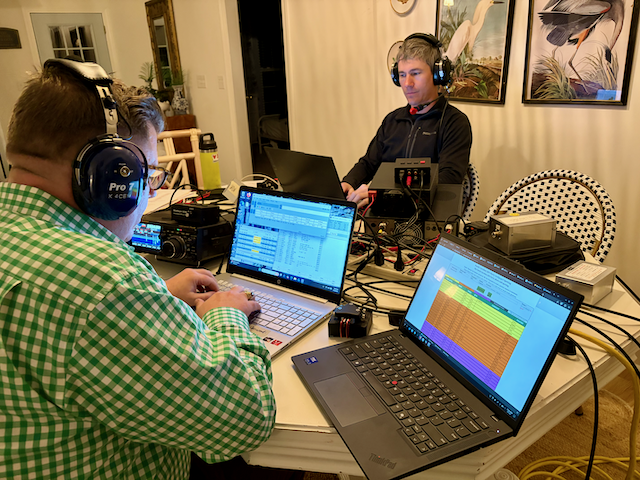 L-R: Carl W8WZ operating CW, John K4EB operating phone.
With an hour left in the contest, we had 855 contacts in the log. John was operating SSB and Carl was operating CW. One thousand QSOs was a possibility, but would we make it? With 30 minutes left in the contest, our QSO total was 940. Each station would need to average a QSO-per-minute in order to hit the four digit milestone. Anticipatory glances were exchanged as we edged closer to the end of the contest. At long last, we cheered as we crossed the 1,000 QSO mark with 7 minutes left in the contest. We continued to make a few more QSOs and ended our effort with 1,016.
Results
Most of the results in section are from the N1MM Logger+ logging software. The insights to be gleaned from this information is very helpful in determining what worked and what didn’t. Following the contest, we uploaded our unofficial score to 3830scores.com. The final score will need to come from the contest organizers so that the rare county multipliers can be calculated correctly.
N1MM: Score Summary
Here is the Score Summary from N1MM. Disregard the multiplier count and point values. They do not consider the point values of rare counties.
 Band   Mode  QSOs     Pts  Mul  Pt/Q
  3.5  CW     123     369    1   3.0
  3.5  LSB     27      54    0   2.0
    7  CW     259     777   25   3.0
    7  LSB    262     476   51   1.8
   14  CW     150     450   14   3.0
   14  LSB      1       2    0   2.0
   14  USB    137     126    4   0.9
   21  CW      51     153    5   3.0
   21  USB      3       6    0   2.0
   28  USB      3       6    1   2.0
Total  Both  1016    2419  101   2.4
N1MM: Multipliers
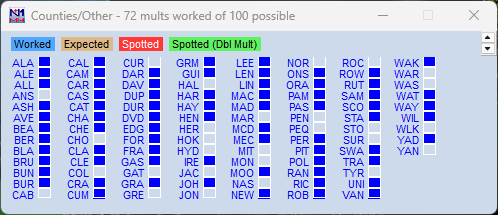
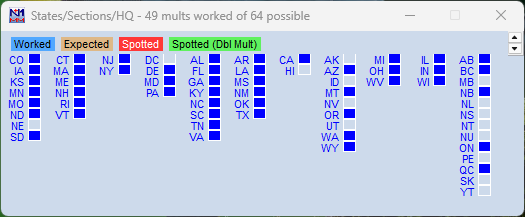
Below are screenshots of the N1MM counties and states multipliers.
N1MM: Bands by Hour
Day        Hr   3.5  7    14   21   28   Tot  Accum
2026-03-01 15   0    98   25   0    0    123  123
2026-03-01 16   0    33   60   0    0    93   216
2026-03-01 17   0    32   5    51   0    88   304
2026-03-01 18   0    48   74   0    0    122  426
2026-03-01 19   0    32   58   0    0    90   516
2026-03-01 20   0    30   50   2    3    85   601
2026-03-01 21   5    64   0    1    0    70   671
2026-03-01 22   23   57   16   0    0    96   767
2026-03-01 23   55   35   0    0    0    90   857
2026-03-02 00   66   92   0    0    0    158  1015
2026-03-02 01   1    0    0    0    0    1    1016
Total 0    150  521  288  54   3    1016 1016
N1MM: Modes by Hour
Day        Hr   CW   PHONE  Tot  Accum
2026-03-01 15   53   70     123  123
2026-03-01 16   33   60     93   216
2026-03-01 17   60   28     88   304
2026-03-01 18   74   48     122  426
2026-03-01 19   30   60     90   516
2026-03-01 20   50   35     85   601
2026-03-01 21   64   6      70   671
2026-03-01 22   96   0      96   767
2026-03-01 23   59   31     90   857
2026-03-02 00   64   94     158  1015
2026-03-02 01   0    1      1    1016
Total      583  433         1016 1016
N1MM: Runs
QSO Parties (US and Canada) - 2026-03-01 1500Z to 2026-03-02 0059Z - 1039 QSOs
N4BCJ Runs >10 QSOs: for computer named: LAPTOP-BD1SUO76

2026-03-01 1522 - 1658Z,    7035 kHz, 81 Qs, 50.4/hr W8WZ K4CBW
2026-03-01 1730 - 1746Z,    7275 kHz, 17 Qs, 63.0/hr K4EB
2026-03-01 1757 - 1900Z,    7275 kHz, 54 Qs, 51.2/hr K4EB
2026-03-01 1909 - 1948Z,    7028 kHz, 32 Qs, 48.9/hr W8WZ
2026-03-01 2010 - 2053Z,   14039 kHz, 54 Qs, 75.5/hr W8WZ
2026-03-01 2106 - 2157Z,    7032 kHz, 66 Qs, 77.2/hr W8WZ
2026-03-01 2201 - 2217Z,    7032 kHz, 19 Qs, 73.9/hr K4CBW
2026-03-01 2229 - 2242Z,    7032 kHz, 16 Qs, 73.4/hr K4CBW
2026-03-01 2245 - 2321Z,    7032 kHz, 33 Qs, 53.7/hr K4CBW
2026-03-01 2336 - 2351Z,    3534 kHz, 20 Qs, 77.3/hr K4CBW
2026-03-01 2356 - 0053Z,    3534 kHz, 68 Qs, 71.2/hr K4CBW W8WZ

QSO Parties (US and Canada) - 2026-03-01 1500Z to 2026-03-02 0059Z - 1039 QSOs
N4BCJ Runs >10 QSOs: for computer named: LAPTOP-L54GHR8C

2026-03-01 1506 - 1534Z,    7180 kHz, 48 Qs, 104.4/hr K4EB
2026-03-01 1554 - 1636Z,   14234 kHz, 71 Qs, 100.2/hr K4EB
2026-03-01 1707 - 1751Z,   21000 kHz, 51 Qs, 68.7/hr K4CBW
2026-03-01 1757 - 1857Z,   14066 kHz, 81 Qs, 80.9/hr K4CBW
2026-03-01 1913 - 1959Z,   14247 kHz, 58 Qs, 76.1/hr K4EB
2026-03-01 2041 - 2057Z,    7181 kHz, 21 Qs, 76.5/hr K4EB
2026-03-01 2219 - 2237Z,   14247 kHz, 16 Qs, 56.0/hr W8WZ
2026-03-01 2244 - 2315Z,    3600 kHz, 31 Qs, 59.5/hr W8WZ K4EB
2026-03-01 2316 - 2341Z,    3820 kHz, 18 Qs, 42.7/hr K4EB
2026-03-01 2351 - 0000Z,    7258 kHz, 14 Qs, 89.7/hr K4EB
2026-03-02 0001Z - 0059,    7259 kHz, 90 Qs, 93.6/hr
QSO Maps
These maps show the broad geographic reach of our signals. Skip zones are apparent when viewing 20 and 15-meter bands. These maps were created with https://qsomap.cqgma.org/ADIF_to_Karte.php.
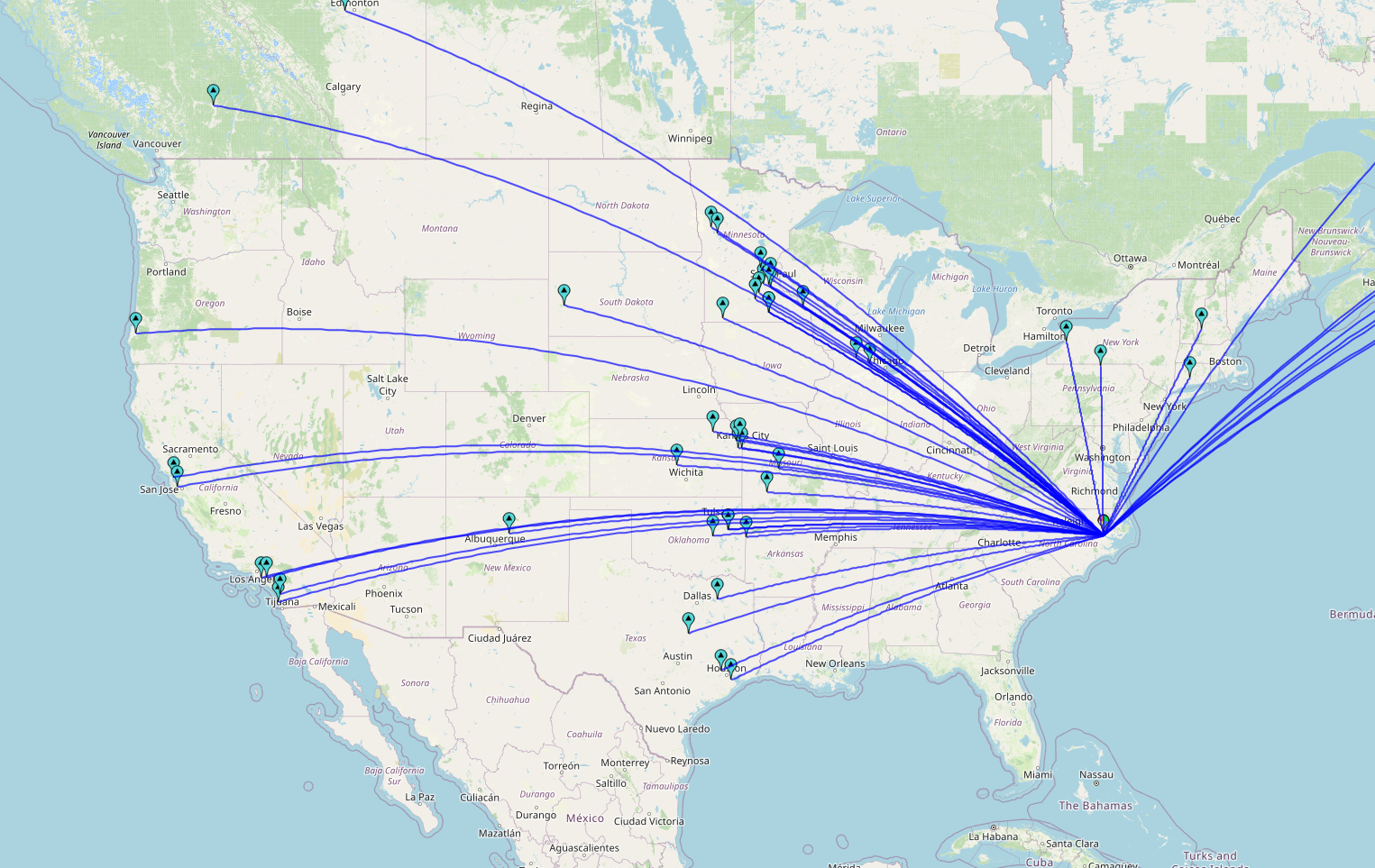 15-meter QSO map for N4BCJ.
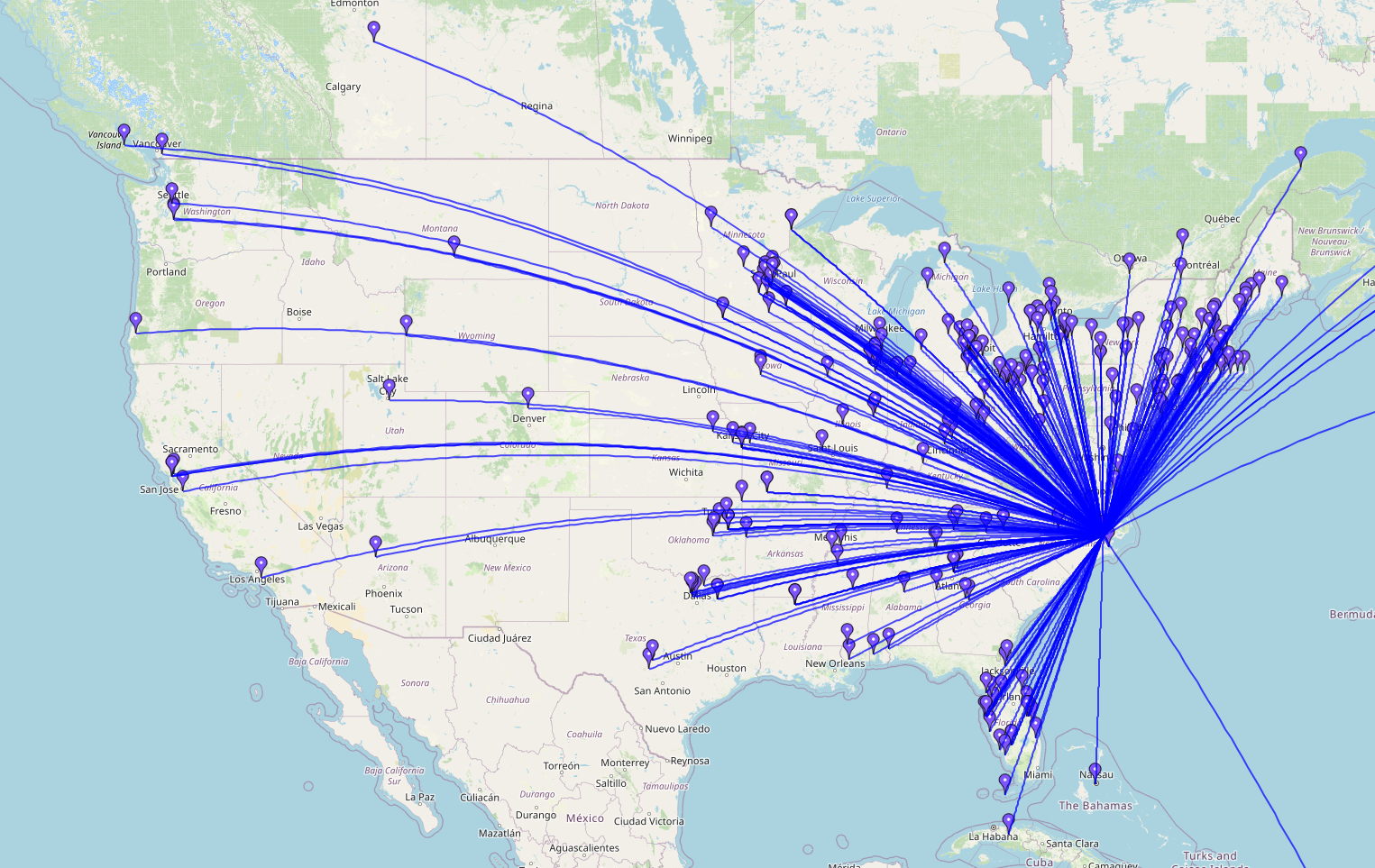 20-meter QSO map for N4BCJ.
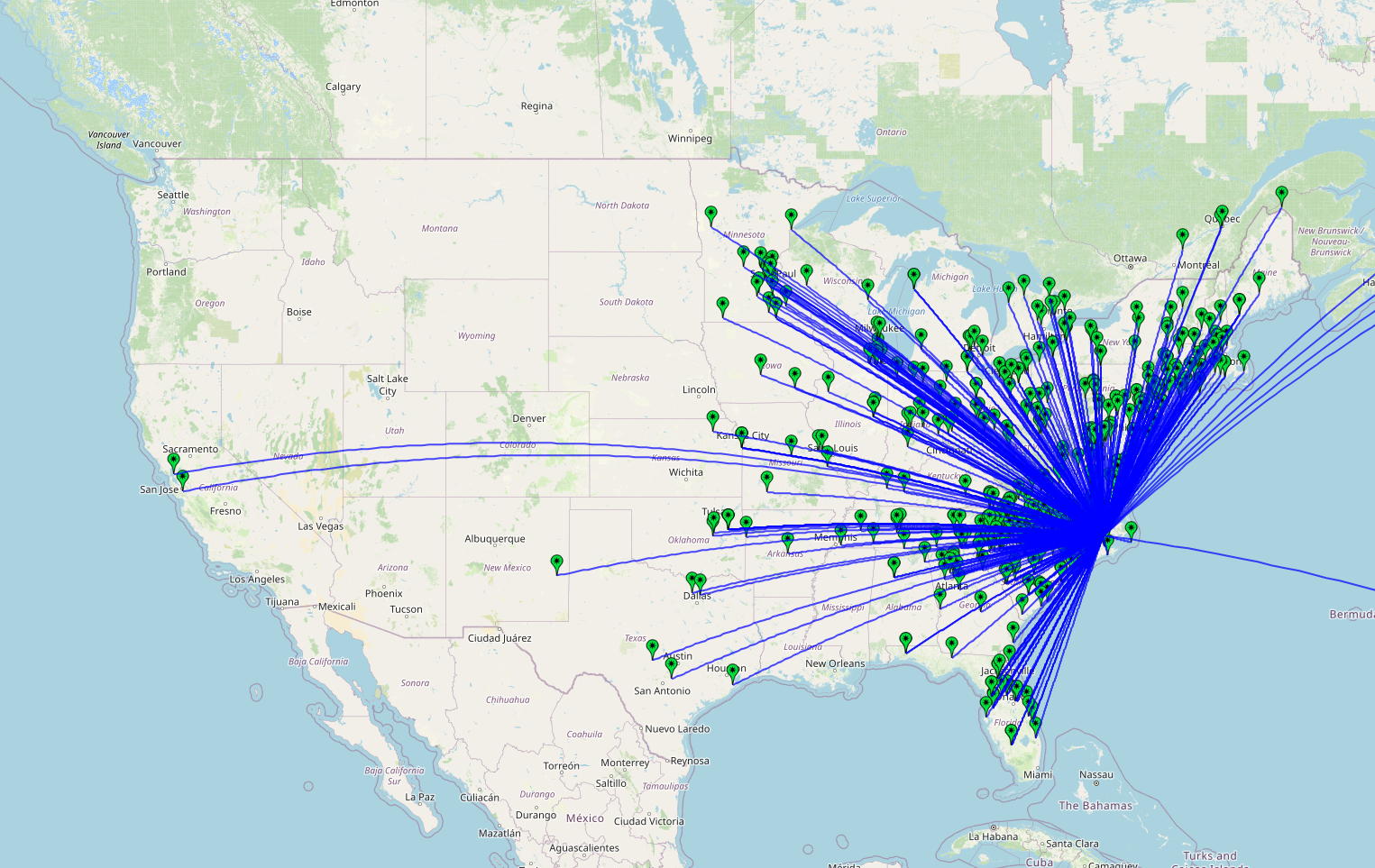 40-meter QSO map for N4BCJ.
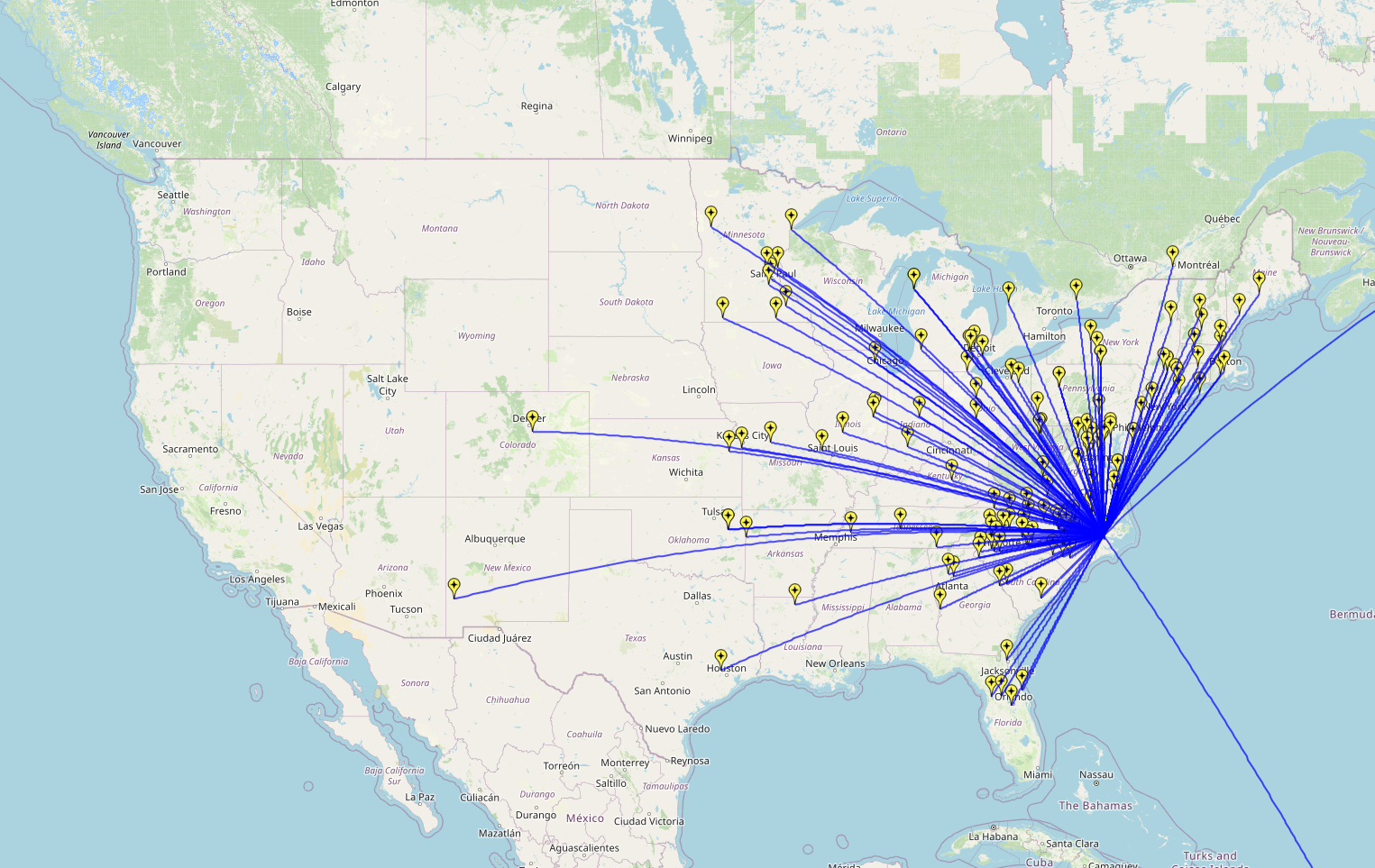 80-meter QSO map for N4BCJ.
In Conclusion
The three of us were thrilled with our effort. In the hours after the contest, we would remark to each other “one thousand contacts,” grin, and continue packing up. On the ride back to Raleigh, we discussed what worked and what didn’t. We chatted about different antenna configurations for multi-multi stations and how we might reduce RFI. Lots of good things to think about before visiting the vendors and fleamarket spaces at RARSfest in April and Hamvention in May.
73 DE K4CBW